
The Systems Transformation Hub welcomes President von der Leyen’s increased focus on climate resilience, including her call to step up dramatically on preparedness. But, as the range of challenges addressed in her speech showed, Europe’s resilience is broader than climate. It is physical, ecological, social, economic and institutional, and fundamental to Europe’s security and competitiveness.
These are not separate crises. They are interconnected and should be tackled as such. Europe’s resilience cannot be built through separate responses to separate risks. We need to understand how environmental, social, economic and technological pressures move across the systems on which we all depend, such as water, food provision, energy, housing and mobility, where vulnerabilities arise, and whether action in one area shifts risk elsewhere.
For Europe to thrive, it needs a foundation of provisioning systems that meet the essential needs of its citizens, remain viable under pressure and operate within planetary boundaries. These systems are interdependent: disruption in one can raise costs, reduce capacity or create new vulnerabilities in another.
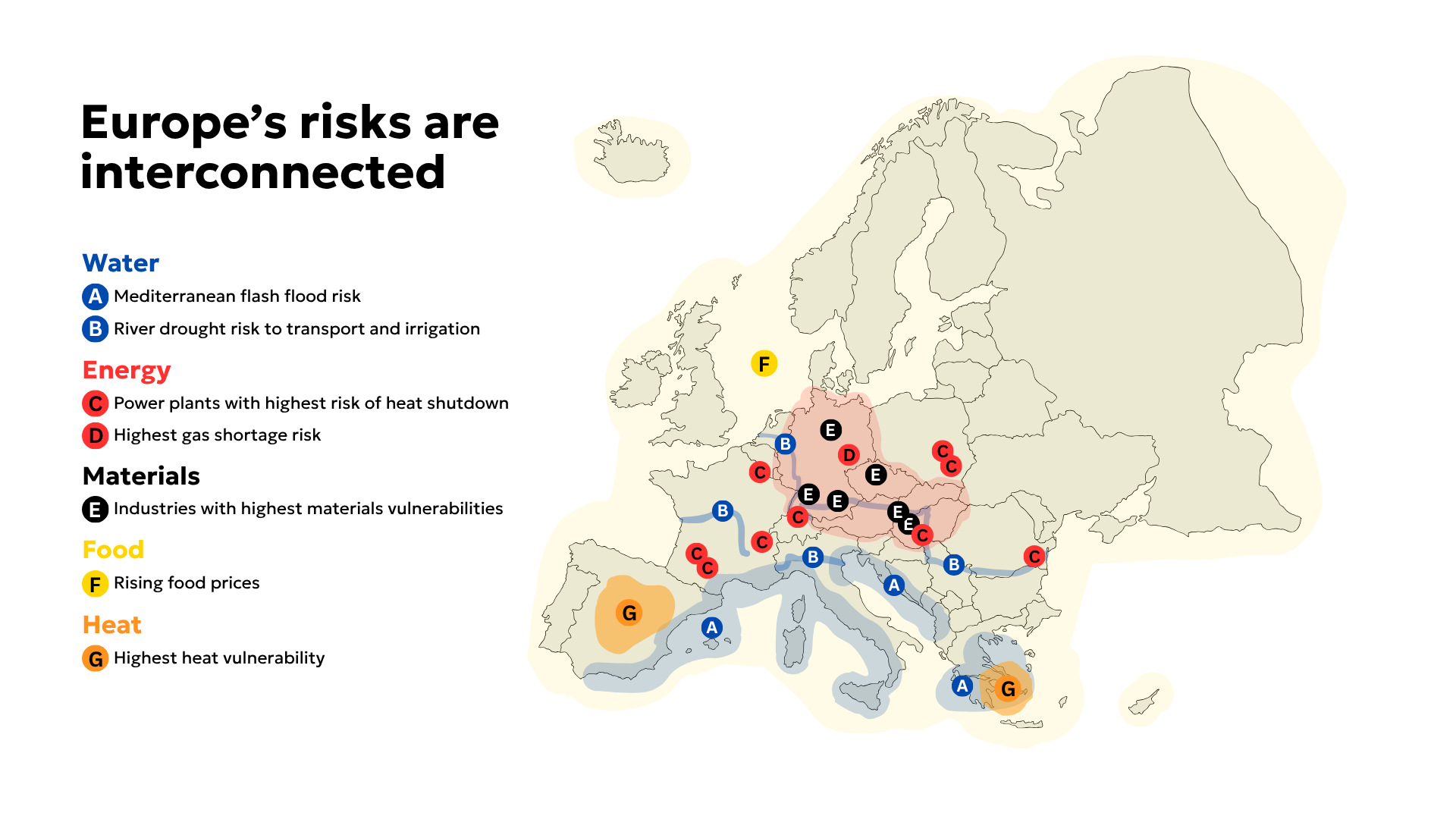
This summer’s drought shows how risks cascade. Crop losses, constraints on power generation and river transport, and growing competition for water coincided with rising demand from data centres and industry. What begins as a climate pressure moves through Europe’s natural systems, infrastructure, economy and society. Treating each risk separately can reinforce rather than reduce the underlying vulnerability.
Navigating this complexity means anticipating where interacting pressures could push environmental, social and economic systems past tipping points, and acting before disruption cascades. Systems thinking helps policymakers identify the connections, dependencies and possible interventions.
Resilience should be the capacity of interconnected provisioning systems to continue meeting essential needs through shocks and longer-term change, while adapting, reorganising and transforming the conditions that create or transmit vulnerability and risk. It is not about returning to normal as quickly as possible. It means meeting essential needs under changing conditions while reducing the dependencies that make future shocks more damaging.
This capacity depends on enabling economic, financial and governance systems; healthy ecosystems; human agency and skills; social cohesion; and decisions that uphold human rights, the rule of law and public legitimacy.
Putting this definition into practice changes what Europe seeks to protect, how it understands vulnerability and who shapes decisions. The starting point is reliable and affordable access to essential needs such as food, water, energy, health, housing and mobility, rather than preserving every existing technology or business model.
Resilience requires changing the architecture that produces vulnerability by diversifying supply, reducing dependence on imported inputs, lowering energy and material demand, restoring ecosystems and retaining spare capacity. It also means building the ability to withstand disruption, adapt as conditions change and transform structures that no longer work. Nature, human capital, strong communities and trusted institutions must therefore be treated as essential infrastructure.
Finally, resilience must be governed democratically: affected communities need a role in decisions, while monitoring and warnings must be connected to clear responsibilities, available finance and agreed action.
The following 5 actions translate these principles into practice:
Europe’s security and competitiveness depend on provisioning systems that can withstand disruption without deepening social or ecological pressures. Reducing energy and material demand, strengthening ecological foundations and maintaining the capacity to adapt can make Europe less exposed while creating space for innovation.
To help Europe thrive, the Systems Transformation Hub will expand its Resilience by Design series with an online platform. It will assess Europe’s key provisioning systems and their long- and short-term risks. It will also host situation rooms that bring relevant actors together to work through scenarios and options for responding when pressures converge.